Shells, Kernels, and Contracts: Finding the Real Margin in The Gambia's Tree-Crop Economy
The Gambia is routinely introduced to foreign investors through its coastline. That framing is useful for hotel developers and largely irrelevant to anyone looking at the country's agricultural economy, where tree crops — cashew and groundnut in particular — underwrite rural incomes, seasonal employment, and a meaningful share of export receipts.
The sector is not undiscovered. Buyers in India and Vietnam know it well, and European edible-oil and confectionery firms have sourced from the region for decades. What remains underdeveloped is the middle of the chain: the processing, storage, and export-logistics layer that sits between a farmer delivering a sack at a buying station and a finished product reaching a port. That layer is where capital is scarce, where technical requirements are specific, and where an investor can plausibly earn something other than a commodity spread.
Two Crops, Two Very Different Economics
Groundnut is the historic crop and the more mature market. The value chain runs from smallholder production through licensed buying, decortication, oil pressing, and cake or meal production for animal feed. Export of raw nuts persists, but the pricing power sits with processors who can guarantee low aflatoxin content — a food-safety constraint that has closed European borders to West African lots more than once and remains the single largest determinant of whether a given ton trades at a premium or a discount.
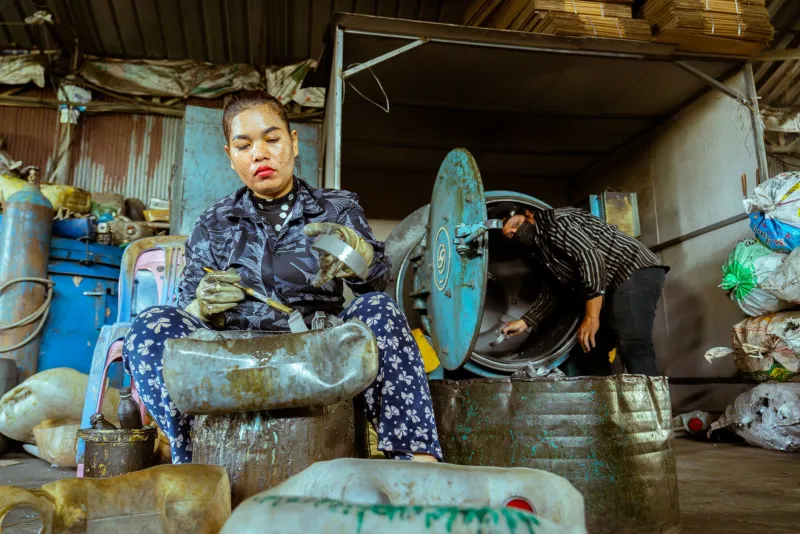
Cashew is the growth story. The Gambia exports the overwhelming majority of its crop as raw cashew nuts, with the shelling and kernel extraction happening abroad. Raw nut export is a volume business with narrow spreads, freight exposure, and quality penalties that can erase a season's assumed margin. Kernel processing onshore — shelling, peeling, grading, packing — is labor-intensive, capital-light relative to other agro-processing, and structurally under-supplied in-country.
The asymmetry is the point. In a raw-export model, the country captures a fraction of the end value and the investor captures a fraction of a commodity cycle. In a processing model, the investor is selling a graded, food-grade product into a buyer who needs consistency rather than a trader who needs tonnage.
Where the Margin Actually Sits
A useful way to think about it: for every ton of raw cashew nuts, only roughly a fifth to a quarter emerges as usable kernel. The remainder becomes shell, testa, and rejects — some of which have commercial value (cashew nut shell liquid, in particular) and much of which does not. Kernel outturn is therefore the number that governs the entire venture, and it varies with variety, moisture at harvest, storage conditions, and the competence of the shelling line.
Three margin levers matter more than headline crop prices:
- Outturn and grade mix. A plant running at 22 percent outturn with a strong whole-kernel ratio looks nothing like one running at 18 percent with broken-kernel discounts, even at identical raw-nut costs.
- Byproduct recovery. Shell liquid, testa, and rejected kernels sold as splits or pieces are not trivial. Facilities that treat them as waste leave real revenue on the floor.
- Working-capital cycling. Tree crops are seasonal. A processor buys inventory in a compressed window and sells across twelve months. The financing cost of carrying that inventory, in a market where local lending rates are high, is frequently the difference between a viable operation and an unviable one.
In groundnuts, the equivalent levers are aflatoxin control, oil extraction yield, and the quality of the cake or meal byproduct sold into feed markets. A press line without a testing regime is a commodity business with extra steps.
The Constraints That Do Not Appear in a Pitch Deck
Storage and moisture control. Cashew deteriorates quickly if held damp; groundnut becomes a food-safety liability. Warehousing with proper ventilation and monitoring is scarce and underpriced as a risk.
Power and cold-chain-adjacent reliability. Processing equipment tolerates voltage fluctuation poorly. Budget for backup generation and treat it as a permanent operating cost, not a contingency.
Port and corridor logistics. The Port of Banjul handles the country's trade, but the draft and capacity limits are well known, and some exporters route through Dakar in Senegal or rely on transshipment. Transit time and freight cost belong in the model from day one, not as an afterthought.
Trade preferences. Access to US and European markets is shaped partly by preference programs whose renewal cycles are a live policy question. Do not underwrite a project on the assumption that a tariff advantage is permanent.
Four Questions to Answer Before Wiring Funds
1. Who buys the output, and on what terms? An offtake agreement with a named counterparty, a stated grade specification, and a pricing formula is worth more than any projection. Without one, you are building capacity and hoping.
2. Who holds the land and the assets? Land tenure in The Gambia is substantially customary, with leasehold arrangements layered on top. The security you actually obtain — over land, buildings, and equipment — depends on how the structure is documented locally. This is a question for Gambian counsel, not a generalist.
3. Who runs the plant? Processing is an operating business. The gap between a well-run and a poorly run shelling line is measured in outturn percentage points, and that gap is human. Management quality, and the depth of the bench behind it, should be diligenced as thoroughly as the financials.
4. How does the money come home? The dalasi is convertible but not frictionlessly so, and there is no US–Gambia tax treaty to smooth withholding and double-taxation questions. US investors also carry familiar reporting obligations — foreign account disclosures chief among them — that need to be planned for at the point of structuring, not at tax time.
Structures and the Diaspora Advantage
Direct equity in an operating company, a holding vehicle above a local subsidiary, and negotiated debt with a revenue-linked coupon are all workable, and each carries different exposure to currency, governance, and exit. What matters is that the structure matches the risk being taken: a minority position in a family-run processor without board rights, information rights, and a defined dividend policy is a donation with paperwork.
Diaspora investors hold a genuine edge here that is difficult to replicate. A co-investor who can sit in the room, read the local market, and verify what a manager reports is a control, not a sentiment. Where a Gambian-American partner is available and properly aligned, their presence in the governance structure is often worth more than a marginally lower entry price.
The Bottom Line
Tree crops will not produce the headline returns of a coastal resort development, and they should not be sold that way. What they offer is a real, physical, export-earning business with identifiable buyers, a clear technical basis for underwriting, and a structural gap in processing capacity that has persisted because it is unglamorous rather than because it is unprofitable.
For an American investor, the discipline is familiar: understand where in the chain you sit, price the working capital honestly, secure the offtake before the capex, and treat the operating partner as the investment. The cashew does not care about the pitch — only about the outturn.